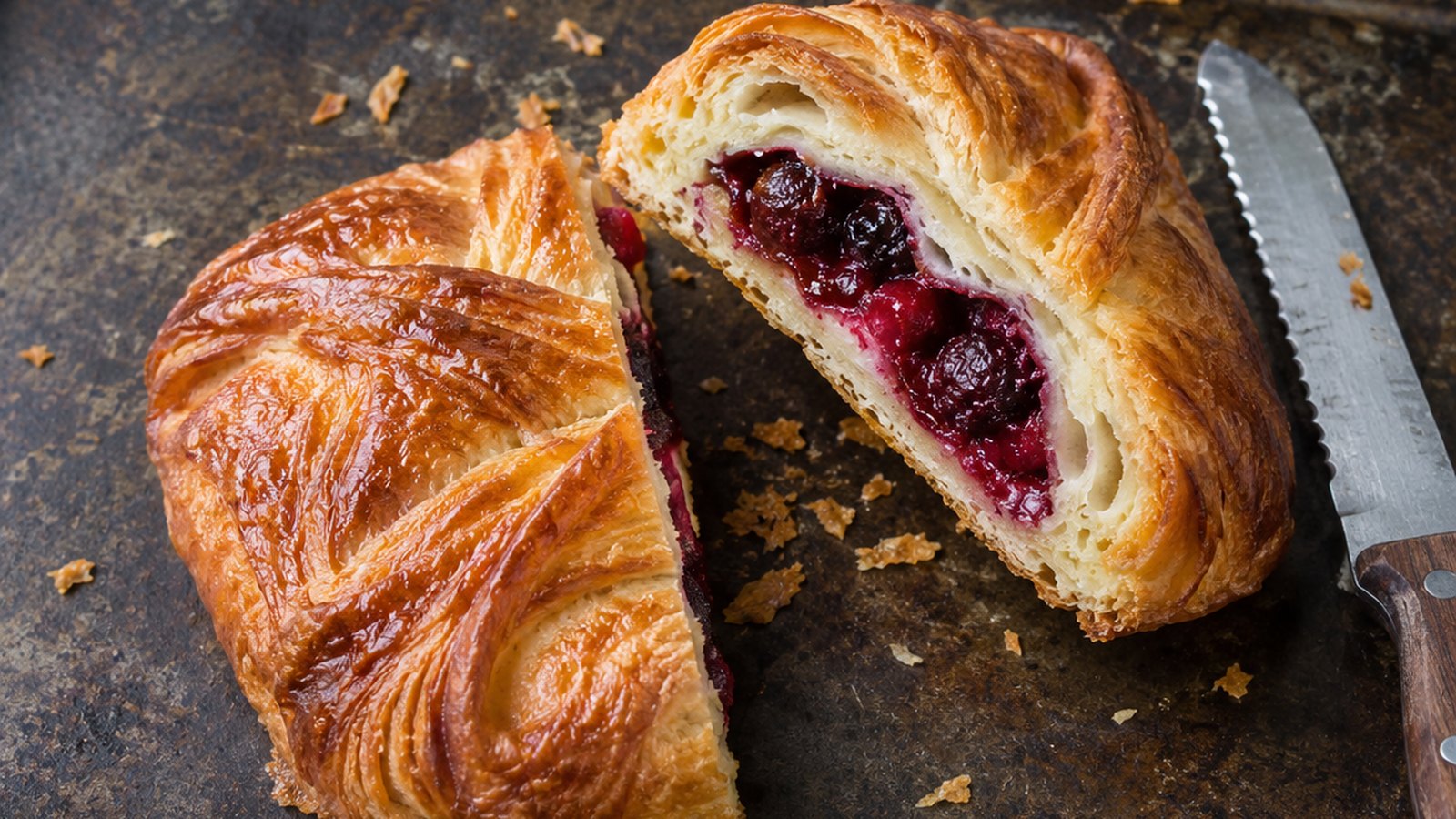
Holding shape in the oven
A filling that spreads or boils out is usually carrying too much free water for the solids it has. Raising total solids is the blunt instrument; the better route is a starch or pectin system chosen for the oven programme, so the filling sets as it heats rather than thinning. A filling built for 180 °C for 18 minutes behaves differently at 220 °C for 9 minutes, which is why we ask for the programme and not just the word "bakery".
Staying where it was deposited
Open-top products such as danish and tarts fail differently from enclosed ones. On an open top, the filling has to resist flowing sideways as the dough relaxes and the filling loosens. In an injected or enclosed product, the filling has to survive pressure and not blow the seam. The same fruit can serve both, but the viscosity and the setting system are not the same.
Not browning
Sugars at the surface of an open filling caramelise and can burn before the pastry is done. Adjusting the sugar profile, and in some cases the acidity, keeps the surface from darkening past the point your product should show.
Not soaking the base
Water migrates from filling to dough over shelf life and turns a crisp base soft. Controlling water activity in the filling is the lever here, and it matters more the longer the product sits before it is eaten. A product sold the same day tolerates what a packaged product on a supermarket shelf does not.
Freeze-thaw
Most industrial bakery is frozen at some stage, either as unbaked dough with filling already deposited or as a finished product. Freezing and thawing breaks weak gel systems and shows up as weeping after thaw. A filling intended for frozen bakery is tested through freeze-thaw cycles; one that was not will look fine in a trial and fail in the retail chain.
Keeping visible fruit
All of the above is easier with a smooth filling. If your product sells on visible fruit pieces, the pieces have to be cooked gently enough to stay whole through the deposit and the oven, which we do under vacuum at lower temperature. Piece integrity and bake stability pull against each other, and where you land between them is a product decision to make before the first trial, not after.
How to test it
Deposit on your own line, bake your own programme, then hold the product for its intended shelf life under its intended conditions, including a freeze-thaw cycle if that is how it will travel. A filling that passes a fresh bake and fails at day 14 is a common and expensive surprise.